
Dear Family and Friends,
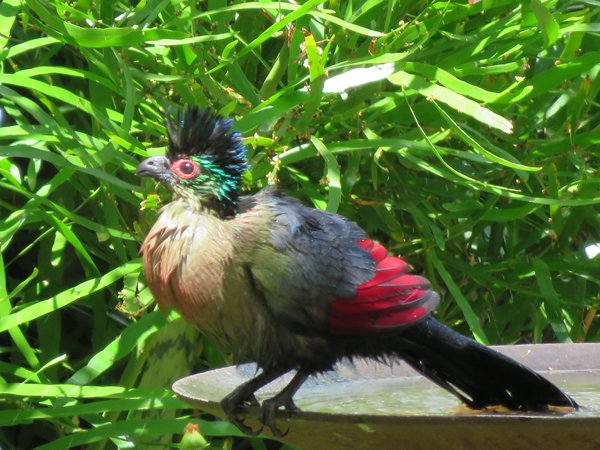
Every morning at dawn the purple-crested Turaco, which used to be called the Red-winged Lourie, is among the first birds to sing. It’s a loud, beautiful call, forever unforgettable, ringing in the quiet of the new day, insisting everyone wakes up and witnesses the arrival of spring. True to its old name, the Lourie has stunning red primary feathers always giving away its location as it hops along the branches and flies from one fruit tree to the next or splashes with gay abandon in the bird bath. Spring has arrived in Zimbabwe. The Msasa trees are preparing for their spectacular spring colours here in the highveld, expelling their pods as soon as the sun warms them. They are carrying a heavy load this year and the days are filled with the sound of pods cracking, popping and spitting their flat, round, shiny seeds in every direction. With every breath of wind, the leaves from the trees drift down, a slight whisper as they land on the hard, dry thirsty ground below.
As ever, spring brings beauty and hope but in that naked moment, when the last of the leaves have fallen and before the new ones appear, the ugliness of politics and propaganda arrive to fill the pause and to distract attention from the tragedies of everyday life in Zimbabwe.
At a time when Zimbabwe continues to reel from the tragedies of 97 people lost in the Kariba Ferry disaster, and three weeks later, 27 church members died in the Chivhu Bus crash, we heard the unbelievable news about the World Bank and we were staggered.
Zimbabwe’s Minister of Finance, Mthuli Ncube, announced that the World Bank has officially removed Zimbabwe from its list of Fragile and Conflict-Affected Economies. The Finance Minister said Zimbabwe’s GDP grew by 8.3% in 2025 and ZiG inflation dropped by 2.9%. Mr Ncube’s said the World Bank’s decision to delist Zimbabwe was a “direct validation of the country’s ongoing economic turnaround, governance and institutional reforms.”
There was an instant outcry. Former Finance Minister Tendai Biti said Minister Ncube’s “phantom data” does not reflect widespread poverty, unemployment, political polarization and deteriorating public services. He described Zimbabwe’s maternal and infant mortality indicators as “medieval” and accused the Government of “prioritizing appearances over the material conditions facing citizens. “The hard reality is that this is a poor, fragile state,” Mr Biti said.
Lawyer and politician Fadzayi Mahere wrote on her social media page: “Mthuli will do whatever creative mathematics is necessary to push his narrative. The majority of Zimbabweans have been left behind in Mthuli’s “economic growth” fairytale.
While the government spin went on, another story was back in the news, raising eyebrows over the claim of economic recovery. It was the BEAM story, again. BEAM, the Basic Education Assistance Module, is the government’s social welfare programme to assist vulnerable and orphaned children who can’t afford to go to school. The government now owes schools over US$292 million for unpaid school and examination fees for five million children in schools around the country. While the fees remain unpaid, children are vulnerable, never knowing from one day to the next if they will be sent home for non-payment, even though Government says that’s not allowed but it continues to happen because how can schools function without the fees from students? Is this the boasted ‘economic recovery’ when the government can’t even pay school fees for vulnerable children?
While the government pats themselves on the back about what they say is ‘economic recovery,’ it means nothing to the countless people who had had their houses demolished by municipal bulldozers in St Martins in Harare in recent weeks or the thousands who wait to see if they will be next. It means nothing to street vendors who have just been told that they must leave undesignated sites or they would be removed in a nationwide ‘’clean- up operation” next week. It means nothing to 115,000 Zimbabweans who were chased out of South Africa last month, leaving with nothing and returning to nothing; they are undoubtedly going to get caught up in this ‘cleansing.’ It all feels like Operation Murambatsvina in 2005 all over again. My book “Millions, Billions, Trillions,” contains my eye witness stories of that hell. Zimbabwe has not learnt from its past, it just repeats it again and again.
Thank you for continuing to read and share these Letters From Zimbabwe. They may be hard to read but are even harder to live.
Thank you for not forgetting us, the ordinary people of Zimbabwe.
There is no charge for this Letter From Zimbabwe but if you would like to donate, please visit my website.
Until next time, thanks for reading this Letter From Zimbabwe now in its 26th year, and my books about life in Zimbabwe, a country in waiting.
Ndini shamwari yenyu (I am your friend)
Love Cathy 3 September 2026. Copyright © Cathy Buckle https://cathybuckle.co.zw/
My new annual Photobook, “Zimbabwe’s Timeless Beauty The 2026 Collection” and my Beautiful Zimbabwe 2027 Calendar are both now available from https://cathybuckle.co.zw/ or https://www.lulu.com/spotlight/cathybuckle2018